
Education
How Fire Starts, Spreads, and How We Can Stop It
Fire can often be unpredictable, one moment it’s a spark, and the next, a whole room is engulfed. But in fire safety, nothing about fire is random. In fact, it behaves according to simple scientific rules, and once you understand them, you begin to see fire not as a mystery, but as something you can manage, prevent, and control.

The fire triangle: the simplest way to understand fire
One of the easiest ways to understand fire is to think of it like a recipe. You only need three ingredients: fuel, heat, and oxygen. Fuel is anything that can burn such as packaging, furniture, cooking oil, plastics. Heat is the energy that raises that fuel to its ignition point. Oxygen, usually from the air around us, feeds the reaction. Remove any one of these three elements, and the fire stops. It’s that simple.
This is also why everyday habits matter so much. A cluttered storeroom gives fire more “food.” A poorly maintained electrical systems could potentially provide the “heat.” And improper storage of flammables makes it far easier for the recipe to come together.
At its core, fire prevention is all about good discipline, keeping fuel under control, separating ignition sources, maintaining equipment, and storing materials safely. When you understand the fire triangle, every safety practice suddenly feels more logical.
Why small fires become big fires
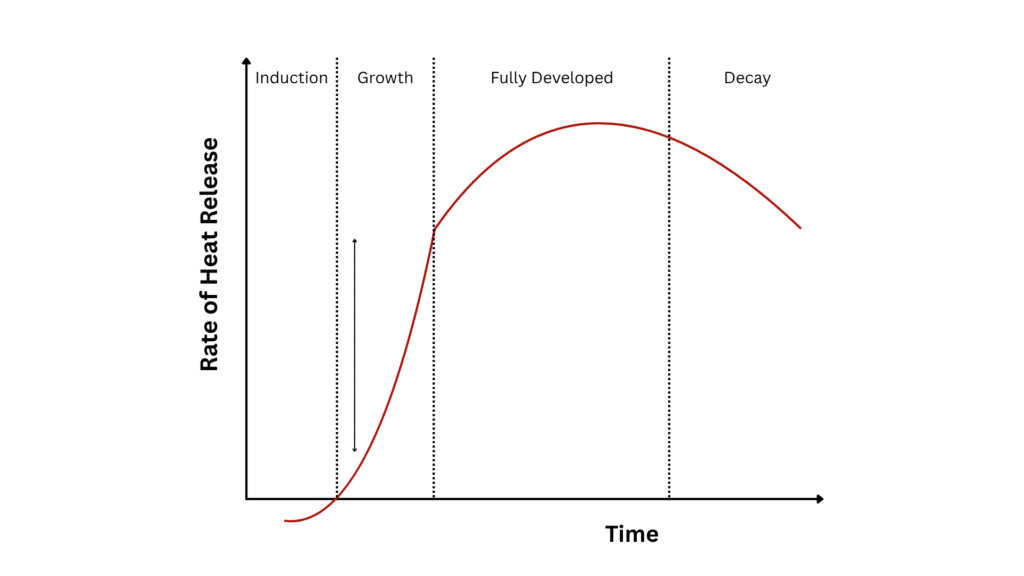
A fire almost never starts big. It always begins with something tiny, it could be from an overheated cable, a spark from hot work, a forgotten candle, a bit of oil smoking on a stove. But here’s the dangerous part: fires grow on a curve, not a straight line.
In the early moments, a fire looks manageable. But as heat builds up, the space above the fire becomes filled with a layer of hot smoke. That layer gets hotter and thicker until eventually it crosses over the flashover zone.
Flashover is every firefighter’s nightmare. It happens in the growth stage and in that moment, the whole area could potentially ignites almost instantly. Temperatures can jump from a few hundred degrees to over a thousand in seconds. Eventually when all the fuel is consumed or oxygen is depleted, we will get to the decay zone where fire starts to burn out.
This is why early detection and immediate action save lives. An alarm warns you, but a portable fire extinguisher allows you to fight the fire in those crucial first seconds before it reaches ‘flashover’.
Why this matters for everyone and not just your FSMs
While there are significantly more to this, the fundamentals of fire science helps to put things into perspective. It’s about seeing your environment differently and how to fight fire using logic when time is needed. you begin to understand why fire safety rules exist and why ignoring them can have real consequences.
At Asiatic Fire System, our goal isn’t just to supply systems and equipment. It’s to help people understand the science behind fire so they can make smarter decisions about protecting their buildings, businesses, and the people inside them.
If you want to assess your facility’s risks or strengthen your fire safety plan, reach out to our team, we’re always here to help.
When Should You Call for Help?
One of the most important things to understand about fire is this: if a fire is growing faster than you can control, or if you are ever unsure, leave and call for help immediately. “SCDF advises that small incipient fires may be tackled with an SCDF-approved fire extinguisher only if it is safe…” But the moment the fire produces thick smoke, grows beyond the point of a simple extinguisher, or begins to fill the room with heat, it is no longer a “manageable fire.” At that point, your priority should be evacuation and raising the alarm, not fighting the flames.
It’s also important to remember that smoke can be extremely dangerous as well. If visibility drops or smoke begins accumulating near the ceiling, treat it as an immediate danger. Knowing when not to fight a fire is just as important as knowing how fires behave and it can be the decision that saves lives.
Emergency Ambulance & Fire SCDF – 995
Non-Emergency Ambulance – 1777
Police Emergency – 999
Emergency Medical Services SMS for the DHS (deaf, hard-of-hearing, and speech impairment) community – 70995
Source: