
Education
What You Need to Know About PFOS/PFAS Foam Being Phased Out

If your building, factory, refinery, hangar or vessel still relies on aqueous film forming foam, AFFF, for fire protection, the clock is ticking. From 1 January 2026, Singapore has sharply restricted the use of firefighting foams containing PFAS, the so-called “forever chemicals.” Globally, the same shift is happening in the European Union, on board ships under SOLAS, and across the globe.
This is not just a paperwork exercise. It is a full system change that affects what you store, how you fight a fire, what you flush from your pipework, and how you dispose of legacy stock without breaking environmental law. Here is what is changing, why it matters, and why swapping foam is not as simple as it sounds.
What is PFAS, and why is the world walking away from it?
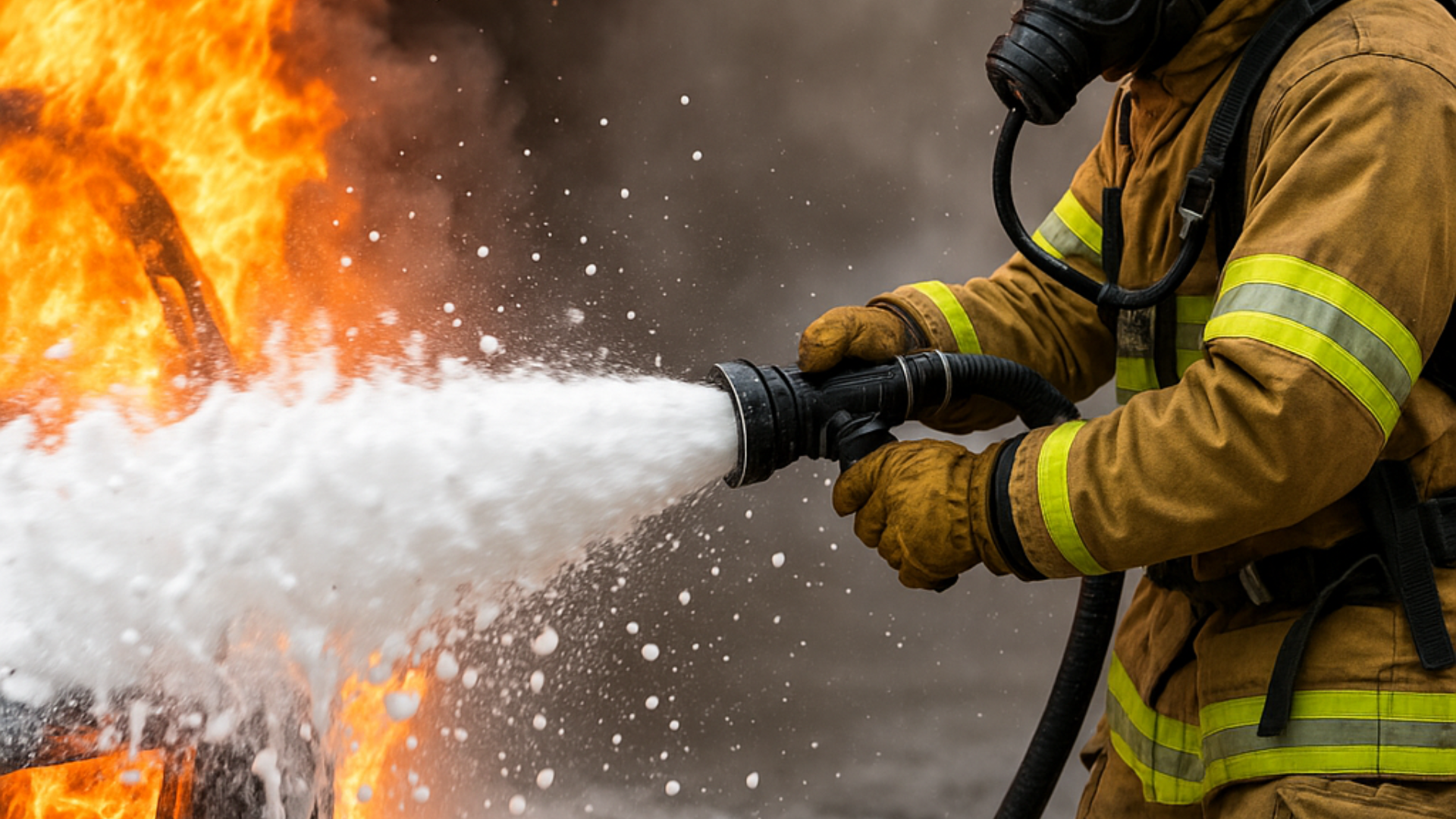
Per- and polyfluoroalkyl substances, also known as PFAS, are a family of synthetic chemicals prized for repelling water, oil and heat. For decades, AFFF used PFAS to form a thin film over burning fuel, smothering flammable liquid fires faster than almost any other agent. Highly effective in fire protection, but with a significant environmental cost.
PFAS does not break down in the environment. It builds up in soil, groundwater and human bodies, which is why scientists call them forever chemicals. The US Environmental Protection Agency states that current peer-reviewed research links PFAS exposure to reproductive effects, developmental effects in children, increased risk of certain cancers, immune system impacts, hormonal interference and increased cholesterol.
The European Commission, when adopting its 2025 restriction, estimated that without action around 470 tonnes of PFAS would continue leaking into European soil and water every year from firefighting foam alone. That kind of number is what moved regulators from “monitor” to “phase out.”
The Singapore regulation: NEA's 2026 deadline
Singapore is a party to the Stockholm Convention on Persistent Organic Pollutants and with the initiative implemented globally, the National Environment Agency has also issued a notice on 15 March 2024 announcing that, with effect from 1 January 2026, the country will phase out the import and use of firefighting foams containing PFOA and PFOS, including their salts and related compounds.
After 1 January 2026, foams containing these chemicals will only be permitted if trace contaminant levels stay below the following thresholds:
- PFOA, its salts and related compounds: 25 ppb
- PFOS, its salts and related compounds: 10,000 ppb
- PFHxS, its salts and related compounds: 100 ppb
Foams above these limits cannot simply be poured away. Companies storing or using them are required to engage a Toxic Industrial Waste Collector licensed by NEA for safe collection and disposal. For affected sites, the message is simple: if your foam is non-compliant on 1 January 2026, you are sitting on a regulated waste, not an asset.
Why this process is not a simple swap
The biggest mistake we often see at AFS is that companies treating this as a procurement decision, where one drum of AFFF is replaced by one drum of fluorine-free foam. It does not work that way.
AFFF works because PFAS forms a vapour-sealing film on the fuel surface. Fluorine-free foam, also known as F3, does not form that film. Instead, it relies on a thicker, more stable foam blanket to smother the fire and exclude oxygen. That changes everything downstream: application rates, discharge times, expansion ratios and the type of nozzle or sprinkler that actually delivers the foam properly. Many existing systems were sized for AFFF performance and may under-perform if F3 is poured in without redesign.
Even after you remove old foam, PFAS residues remain. They cling to bladder tanks, proportioners, pipework, hoses, foam chambers, fire trucks and storage tanks. Industry guidance now warns that simple flushing is not enough. In some cases, individual components or the entire delivery system must be cleaned to a defined standard, or replaced outright, to prevent the new foam from being re-contaminated. The EU regulation explicitly caps residual PFAS at 50 mg/L in fluorine-free foam after equipment cleaning carried out using best available techniques.
How Asiatic Fire System supports your transition
Asiatic Fire System has worked with firefighting foam for decades, from supplying foam concentrates to industrial, marine and offshore clients across Singapore, to integrating various types of foam into the fixed suppression systems we design and maintain, to disposing of legacy foam when those systems are upgraded. We know how these systems behave in real plant rooms, tank farms and engine rooms, not just on paper.
After speaking to our customers, we know this transition can be a real pain point. The regulations come from different bodies, the technical guidance from manufacturers does not always agree, and the cost of getting it wrong is high. That is exactly why we want to help. Our goal is simple: make your move away from PFAS foam straightforward, defensible and fully compliant, with as little disruption to your operations as possible.
Our service covers the full PFAS foam transition lifecycle:
- Consulting and assessment.
- Foam selection and specification.
- Disposal coordination.
- System cleaning and transition.
- Compliance and documentation.
Whether you operate a tank farm, refinery, hangar, warehouse with flammable liquids, MCST plant room, or a fleet of vessels, you do not have to navigate this alone. Talk to AFS about a PFAS foam transition assessment for your site or vessel and let our experience carry the complexity for you.