
Education
Conventional vs Addressable Fire Alarm Systems Singapore
Conventional vs Addressable Fire Alarm Systems: Which Does Your Building Need?
Conventional vs Addressable Fire Alarm System Singapore is one of the most common comparisons for building owners, facility managers and developers. Choosing the right fire alarm system depends on your building size, Fire Code requirements and maintenance needs.
In a nutshell, a conventional fire alarm system simply tells you a fire is somewhere in a zone whereas an addressable system tells you exactly which device has activated. Smaller, simpler premises are usually well served by a conventional system, while larger, taller or more complex buildings requiring pinpointing the source quickly matters are better suited to an addressable one. Both are legitimate under Singapore’s Fire Code, provided they comply with SS 645:2019.
Choosing between the two is one of the most common questions building owners and facilities managers in Singapore ask us, and it is rarely as simple as “newer is better.” The right system depends on the size and layout of your building, how it is being used, and how quickly your need to locate and respond to an alarm. This guide explains the practical differences, what the Singapore Fire Code requires, and how to make the call for your building.
Why this decision matters in Singapore
In 2025, the Singapore Civil Defence Force (SCDF) responded to 2,050 fires, this is a 3% increase on the year before with fires at non-residential premises rose sharply, up 13.5% to 471 cases. Electrical faults alone accounted for 43.5% of those non-residential fires, precisely the kind of ignition a well-placed detection system is meant to catch early. Especially in Singapore which has dense, vertical, mixed-use developments, the seconds it takes to find the start of a fire can be the difference between a contained incident and a full evacuation. A fire alarm system’s job is not only to make noise nor is it something to tell the people responding where to go. In reality, locating the alarm location, is the heart of the conventional-versus-addressable question.
It also matters commercially. In 2025, the most common fire-safety violation SCDF acted on was non-maintenance of firefighting equipment with over 765 notices, nearly 29% of all Fire Hazard Abatement Notices issued that year. A system that is hard to fault-find is a system that is more likely to drift out of compliance. The technology you choose at design stage shapes how easy and how costly your building is to keep compliant for the next 15 to 20 years.
What is a conventional fire alarm system?
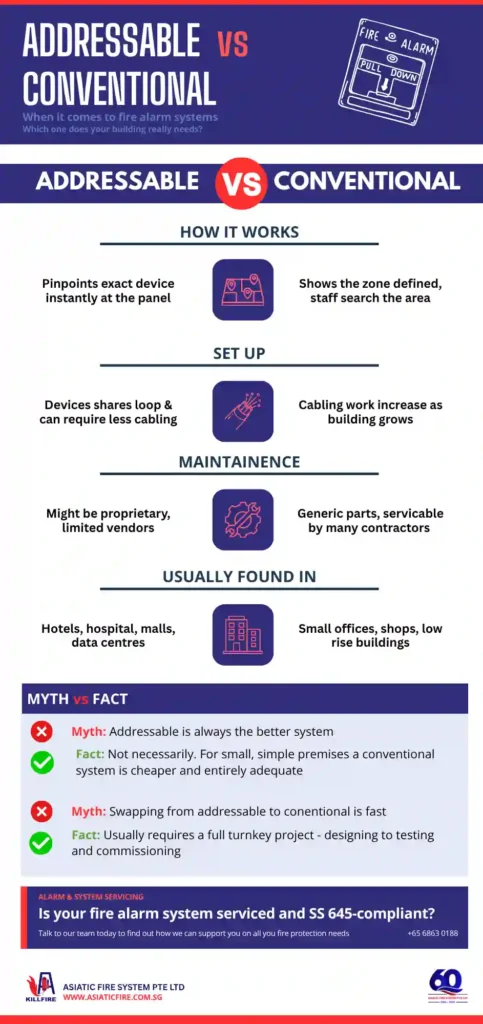
A conventional system divides a building into zones; each wired as its own circuit back to the fire alarm control panel. A zone might be a floor, a wing, or a defined area, often define as zone 1, 2, 3, 4…etc. When any detector or manual call point on that circuit activates, the panel lights up the corresponding zone but not the individual device.
That means staff or responders know the general area in alarm, then physically search that zone to find the activated detector or the seat of the fire. For a small shop, a single-storey workshop or a compact two-storey office, that search is quick and the zoning is intuitive. For a large floor plate or a tall building, it can mean walking an entire zone while the clock runs.
Conventional systems use proven, straightforward technology. Equipment costs per device are lower, and for small premises the total installed cost is usually the most economical option.
What is an addressable fire alarm system?
In an addressable system, every detector, call point and interface module sits on a signalling loop and carries its own unique address. When a device activates, the panel reports the exact device and location, for instance, “Smoke detector, Level 7, Lift Lobby.” This means that the panel has already pinpointed the source.
Beyond location, addressable systems offer capabilities a conventional system cannot. Many brands use analogue sensing with drift compensation, which helps distinguish a genuine fire from dust or steam and reduces nuisance false alarms. They support device-level fault monitoring, cause-and-effect programming (so an alarm on one level can trigger a specific, pre-planned response elsewhere), and far simpler diagnostics during servicing. Because many devices share a single loop, large buildings also need significantly less cabling than the equivalent zoned conventional installation.
The trade-off is a higher upfront cost, driven by more sophisticated panels and addressable devices. In larger and more complex buildings, though, that cost is frequently offset over the system’s life by lower cabling, faster fault-finding and easier maintenance.
Conventional vs addressable: side-by-side comparison
Factor | Conventional system | Addressable system |
Upfront cost | Lower equipment and panel cost; most economical for small premises. | Higher panel and device cost; investment pays back over time in larger buildings. |
Scalability | Adding coverage often means adding zones and dedicated wiring runs; gets cumbersome as the building grows. | Devices are added to existing loops up to the loop’s capacity; expands cleanly for large or phased projects. |
Pinpointing location | Identifies the zone in alarm, not the individual device, staff must search the zone. | Identifies the exact device and its location instantly at the panel. |
| Maintenance and Fault-Finding | Faults are traced manually along a circuit; servicing is simple but diagnosis can be slow in large systems. Detectors need regular physical cleaning. | Device-level fault and status reporting speeds servicing; analogue/signal-processing sensing reduces false alarms and flags detectors needing attention before they fail. |
| Spare Parts, Software and Servicing access | Largely generic, interchangeable components; widely serviceable by many contractors. | Often proprietary, panels, software and parts may be restricted to the manufacturer’s authorised dealers, which can limit who can service it and at what cost. |
Cabling | Each zone is a separate circuit, so cabling increases quickly with building size. | Many devices share a loop, reducing cabling in large installations. |
Often Located | Small offices, retail units, single shops, small workshops, compact low-rise (2–4 storey) premises. | High-rise commercial and residential, hotels, hospitals, shopping malls, large industrial plants, data centres, mixed-use developments. |
What the Singapore Fire Code requires
Here is the important distinction many building owners miss: the Fire Code does not mandate conventional or addressable by name. What it mandates is whether you need a manual alarm system, an automatic detection system, or both, and any system provided must be electrically supervised and comply with SS 645:2019, the Code of Practice for the Installation and Servicing of Electrical Fire Alarm Systems (formerly CP 10).
Under Clause 6.3 of the Code of Practice for Fire Precautions in Buildings 2023 (the current Fire Code, in force from 1 March 2024), the broad requirements run along these lines:
- A building of 2 to 4 storeys with a total floor area per storey greater than 200 m² must be provided with at least a manual fire alarm system. This system is not required to be connected to an approved alarm monitoring station.
- A building of more than 4 storeys must be provided with both an automatic fire alarm system (such as smoke or heat detection) and a manual fire alarm system, regardless of the floor area per storey.
- Where a building contains two or more purpose groups, the strictest requirement among them applies to the whole building.
- Where connection to SCDF’s Operations Centre is required, it is made through an approved alarm monitoring company.
In practice, those codes guide you with the technology choice without dictating it. A small two-storey shophouse needing only a manual system is a natural fit for conventional equipment. A 20-storey mixed-use tower requiring automatic detection across every floor is far better served by an addressable system, because pinpointing and maintainability become decisive at that scale. The Code sets the floor; engineering judgement and a good fire alarm contractor chooses the system that meets your requirements best.
Maintenance: the part that protects you long after installation
Choosing the system is a one-time decision. Maintaining it is a commitment for many years forward. A fire alarm system is only as good as its last service, and SS 645:2019 governs servicing as well as installation. In practice, keeping a system compliant means a layered routine: regular visual checks, periodic functional testing of detectors, sounders, panels and batteries, and a thorough quarterly and annual service, all properly logged.
The system you choose shapes how this plays out. An addressable system lets a technician see at a glance which device on which loop needs attention, and its signal-processing detectors can flag contamination or drift before they cause a false alarm or a missed one. A conventional system needs more hands-on fault-tracing and physical detector cleaning.
A key thing to note is that a proprietary system (often in addressable systems) narrows your choice of servicing partner, sometimes to a single authorised company, which is exactly the kind of detail that determines whether your maintenance cost stays competitive or becomes a captive cost.
The practical takeaway is simple: choose the system that fits your building, then make sure it is serviced by a competent team that can keep it compliant with SS 645 year after year, not just on the day it was installed.
Frequently asked questions
Is an addressable fire alarm system better than a conventional one?
Not universally, it depends on the building. Addressable systems can be better at pinpointing the exact location of an alarm, scale more easily and are simpler to fault-find, which makes them the stronger choice for large, tall or complex buildings. For small, simple premises, a conventional system is usually more cost-effective and entirely adequate. Both must comply with SS 645:2019.
Does Singapore’s Fire Code require a conventional or an addressable system?
The Fire Code does not specify the technology by name. Under Clause 6.3 of the Fire Code 2023, it specifies whether a building needs a manual alarm system, an automatic detection system, or both, this is based largely on the number of storeys and floor area and requires any system to be electrically supervised and compliant with SS 645:2019. The conventional-versus-addressable decision is an engineering choice made within those rules.
Which type of building needs an addressable fire alarm system?
It depends, but it is often found in large and complex buildings such as high-rise commercial and residential developments, hotels, hospitals, shopping malls, large industrial facilities, data centres and mixed-use buildings. In these settings, fast location of an alarm and easier maintenance across many devices make addressable systems the practical standard.
Are addressable fire alarm system always more expensive?
It is common that the upfront cost is higher because the panels and devices are often more sophisticated. In larger buildings, lower cabling and faster fault-finding tend to make it more economical over its full-service life. But there is a hidden cost to check, many addressable systems use proprietary protocols, where parts, software and servicing are restricted to the manufacturer’s authorised dealers. That vendor lock-in can raise the long-term cost of ownership even when the install price looks competitive. It is best to first compare total cost of ownership such as purchase, cabling and ongoing servicing, be sure to ask whether the system is open or proprietary before you commit.
How often does a fire alarm system need to be serviced in Singapore?
Fire alarm systems must be inspected, tested and serviced in line with SS 645:2019 for as long as they are in use. In practice this means routine visual checks, periodic functional testing of detectors, sounders, panels and batteries, and a thorough quarterly and annual service, all recorded in a logbook that SCDF can review if and when requested. From 1 April 2026, Fire Certificate renewals move to a three-year validity, but the duty to keep the system maintained between renewals does not change.
Can I upgrade a conventional system to an addressable one?
Often, yes but it is rarely a simple swap. Because the two systems wire and report differently, an upgrade usually involves changes to wiring, panels and devices, and the new design must be assessed against the current Fire Code and SS 645. The most cost-effective time to choose addressable is at design or major refurbishment stage.
Can any fire protection company service my fire alarm system?
It depends on the system. Conventional systems use largely generic components and can be serviced by most certified fire protection contractor/technicians. Some addressable systems, however, are proprietary the panel software, firmware and spare parts may be restricted to the manufacturer’s authorised dealers, which can limit your choice of maintenance provider and your room to negotiate on price. Open-protocol addressable systems are more flexible. It is worth confirming, before purchase, how many companies in Singapore can actually service the system you are considering.
Talk to our Alarm & System team
Whether you’re choosing a new system, weighing conventional against addressable, or wondering whether an existing system is locking you into one supplier, the most important decision is who keeps it maintained. Asiatic Fire System’s Alarm & System team specialises in fire detection and alarm systems across Singapore, we help to ensure that you are compliant with SS 645 and the current Fire Code, and ready for SCDF inspection year after year.